Construction
Where Construction Debris Actually Goes in Charlotte County
One county rule governs almost everything about construction disposal here, and it is not one most contractors from outside the area have met before.
The rule that governs everything
If you take one thing from this page, take this.
The purpose is straightforward — the county is monitoring out-of-county waste, and the permit is how it confirms a load actually originated here. But the practical effect is that on a permitted job, your disposal cost is tied to a piece of paperwork most people never think about in the same breath as a dumpster.
For contractors, this should be part of the job setup: permit number to the hauler at booking, same as the address. For homeowners with a contractor, ask them for it. For anyone running loads across county lines, it is worth understanding before the scale house explains it to you.
The Zemel Road landfill
Almost everything ends up here.
- 29751 Zemel Road, Punta Gorda — (941) 764-4360
- Monday to Friday 7:00am to 4:30pm, all unloading complete by 5:00pm
- Saturday 7:00am to 12:30pm, all unloading complete by 1:00pm
- Hand-unloading customers must enter at least 30 minutes before closing
- Visa or Mastercard only — cash is not accepted
Those "no exceptions" cut-offs are worth respecting. Turning up at 4:50pm with a trailer to hand-unload does not work, and the card-only rule catches out people who assumed a landfill would take cash.
The site also handles friable and non-friable asbestos and contaminated soil under separate arrangements — that is specialist work, not something that goes in a roll-off.
Clean debris goes free
The most useful thing on the fee schedule, and widely unknown.
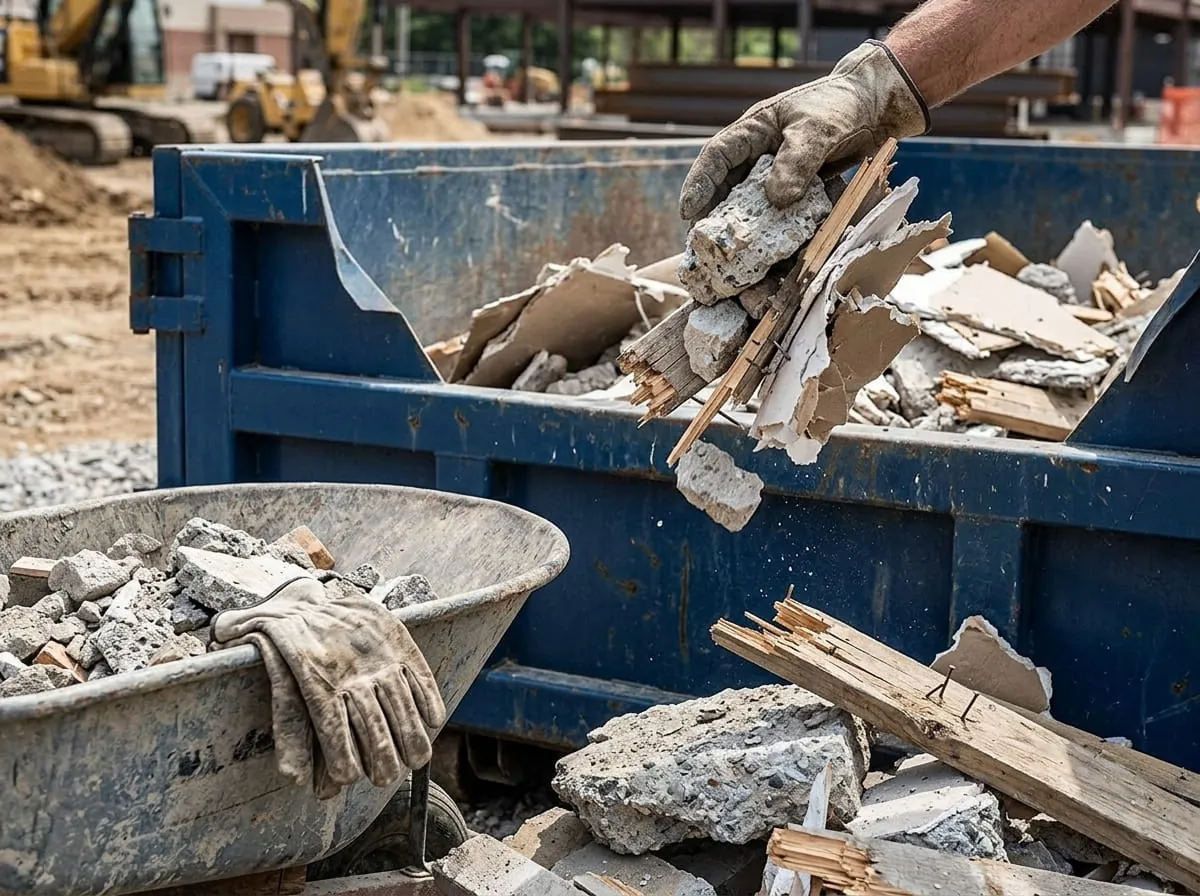
Clean debris — tile, dirt, gravel and small pieces of concrete and pavers — is accepted at no charge. The condition is that it is genuinely clean: not mixed with timber, drywall, plastic or general debris. And dumping in the wrong area carries a $50 charge, so it is a category to get right.
On a hardscape job — a paver driveway coming up, a tile floor, a patio slab — keeping that stream separate takes its disposal cost to zero. That is often the single biggest saving available on a Charlotte County demolition.
Why stream separation saves money
Disposal is priced per ton and the rate varies by stream. Mixed C&D is the most expensive. Clean debris is free. Aluminium and scrap metal have positive value.
Consider a pool deck and cage removal producing six tons of clean concrete and pavers, a container's worth of aluminium screen framing, and some general debris. Mixed together, you pay the C&D rate on all of it. Separated, the concrete costs nothing, the aluminium is worth something, and only the general debris is billed.
Even after paying for extra container movements, that usually wins comfortably.
The five streams worth separating
1. Clean debris
Tile, dirt, gravel, small concrete and pavers. Free at the landfill. Goes in a 10 yard because of weight, always.
2. Aluminium
Screen enclosure framing, lanai structure, soffit, gutter. Extremely common here and genuinely valuable as scrap.
3. Other scrap metal
Copper pipe, ductwork, conduit, steel, appliances.
4. Clean dimensional lumber
Untreated, unpainted. Less of it here than in a stick-frame market because Florida houses are block, but new construction still produces plenty.
5. Cardboard and packaging
New construction generates an extraordinary amount.
Block construction changes the maths
Worth its own section because contractors moving into this market from elsewhere get it wrong.
Florida houses are concrete block with stucco, not stick frame. Interior demolition here produces block, mortar, stucco and tile rather than timber and drywall — and all of that is dense.
The practical consequence: a container that would be half full on a stick-frame gut is at its weight allowance on a block job. Size down and swap more often, rather than filling one big container you cannot legally haul.
The upside is that a lot of that material is clean debris, which is free if you keep it separate.
Asbestos and pre-1980 buildings
Charlotte County has a substantial stock of pre-1980 housing, particularly in Grove City, older Punta Gorda and the early Port Charlotte platting. Floor tile and its mastic are the usual culprits in Florida housing of that age.
Anything from before roughly 1980 should be treated as asbestos-suspect until surveyed. Abatement is licensed work with its own disposal route — the landfill does accept asbestos, but under separate arrangements, and it never goes in a roll-off container.
Get the survey done before demolition starts.
Practical site setup
- Permit number to the hauler at booking. Same as the address.
- Place containers where the work is, not where they are convenient for the truck.
- Label them. A sheet of plywood marked CLEAN CONCRETE ONLY protects a free stream.
- Brief the trades. One subcontractor throwing a lunch bag into the clean debris container turns a free load into a billed one.
- Book swaps into the programme, not on the day you notice the can is full.
- Cover loads in the wet season. An afternoon storm puts weight in an open container.
- Never let debris go to the right of way. The county is explicit that contractors may not dump C&D there.
We are happy to help set that up — tell us the build programme and we will schedule around the trade sequence.
Need a container in Port Charlotte?
Call and describe the job. Three minutes on the phone gets you a size recommendation, a flat rate and a delivery window — and we will tell you if a smaller, cheaper container is the right answer.
Call (941) 206-8052