Permits
Do You Need a Permit for a Dumpster in Port Charlotte?
The short answer for placement is usually no. But there is a second permit question here that catches almost everyone out, and it has nothing to do with where the container sits.
Two different permit questions
People ask "do I need a permit for a dumpster" and mean one thing. In Charlotte County there are actually two separate questions, and the second one surprises almost everybody.
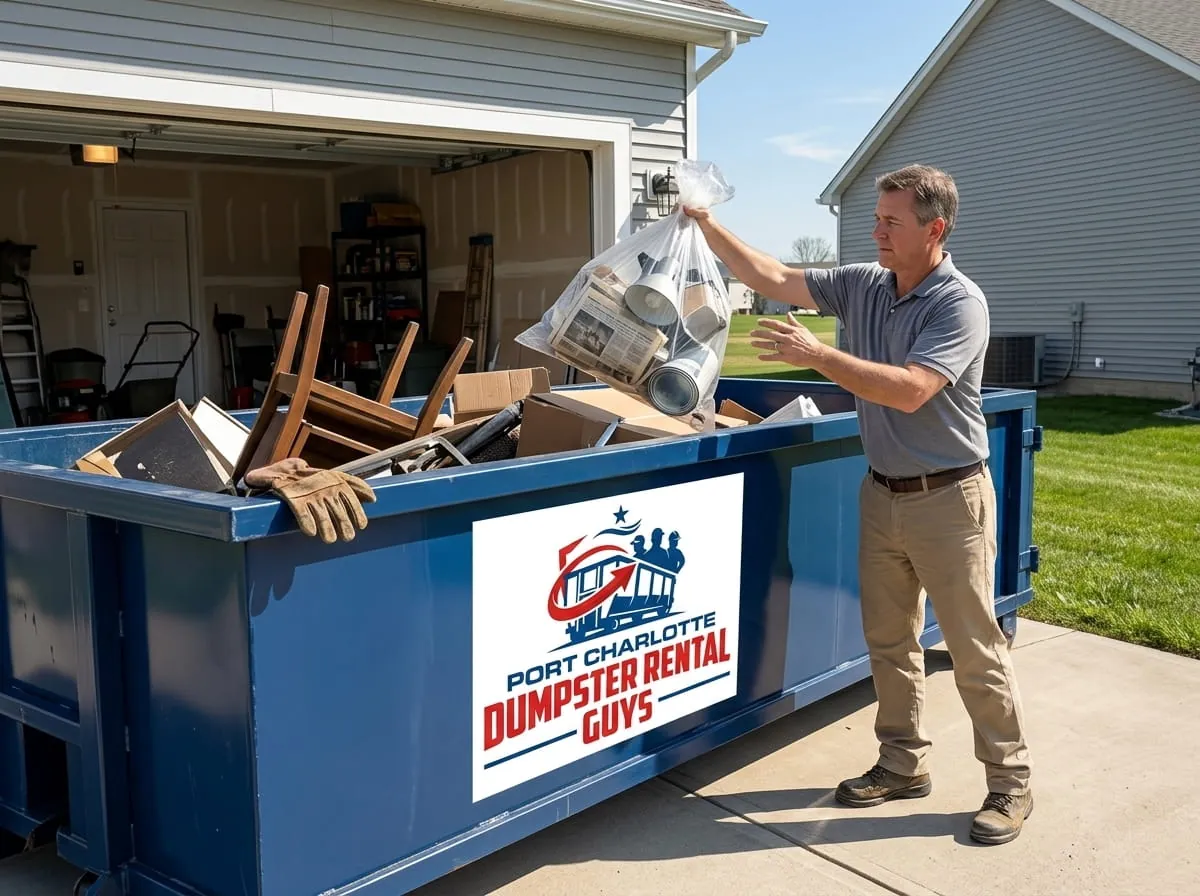
- Placement. Do you need permission to put the container where you want it? Usually no, if it is your own driveway.
- Disposal. Does the job have a building permit, and do you have the number? This one affects what the load costs at the landfill, and it applies even when the container never leaves your property.
Most guides only cover the first. The second is the one that shows up on an invoice.
Placement: private property needs nothing
A driveway, a private parking area, a fenced construction site, a commercial lot you own or lease — all private property, no county or municipal permit required for the container itself.
Two caveats that are not placement permits but function like them. The underlying work may need a building permit — roofing, structural, electrical, plumbing, additions, lanai and pool cage rebuilds, seawalls and docks all generally do in this county. And your deed restrictions may have views, which around here matters a great deal.
Placement: public street needs a permit
Placing a container in the street means occupying public space, and every jurisdiction we work in regulates that. The permit exists for emergency access, sight lines, drainage and night-time visibility.
Our honest advice: if there is any way to get the container onto private property, do that. On the Isles and in Rotonda most lots have room; in historic Punta Gorda some genuinely do not, and that needs arranging in advance.
The permit number the landfill wants
This is the Charlotte County specific, and it is worth reading properly.
Read what that actually does. It ties your disposal cost to your building permit, which are two things nobody normally connects. And it means a hauler who cannot produce a permit number pays roughly double per ton — a cost that lands somewhere, usually on the customer.
What to do: if your job is permitted, have the permit number when you book. Not when the truck arrives. We will ask for it, and it goes with the load.
When it does not apply: household clear-outs, furniture, garage and estate work, general junk. That is not construction and demolition debris and there is no permit to quote.
If you are hiring a contractor, the permit is usually pulled in their name. Ask them for the number and pass it on — it is a thirty-second conversation that can save a few hundred dollars.
Who to call, depending on where you are
| Where the property is | Who to approach |
|---|---|
| Unincorporated Charlotte County - Port Charlotte, Murdock, Harbour Heights, Rotonda, Englewood (Charlotte side) | Charlotte County |
| City of Punta Gorda, including the Isles | City of Punta Gorda |
| North Port | City of North Port / Sarasota County |
| Venice and Englewood (Sarasota side) | City of Venice / Sarasota County |
| Babcock Ranch | Charlotte County, plus the community's own requirements |
Englewood is the one worth double-checking, because the county line runs through the town. Give us the address and we will tell you which side you are on.
Deed restrictions matter more than the county
Across Punta Gorda Isles, Burnt Store Isles, Rotonda West, Babcock Ranch and most of the newer communities, the association matters more in day-to-day practice than the county does — because almost nothing we do needs a county placement permit, but nearly all of it happens inside deed-restricted neighbourhoods.
The themes are consistent: driveway rather than street, removed promptly, load below the rail, site kept tidy. Some want advance notice. A short conversation before delivery day is far easier than a letter afterwards.
Historic Punta Gorda
Downtown Punta Gorda and the surrounding residential streets have genuine preservation interest. For a temporary container on your own property that changes nothing, but the underlying work on a designated property — windows, roofing, siding, exterior alterations — usually needs review before anything starts.
That process takes time. Start it early and treat the container as the last thing to arrange rather than the first.
What we need from you
- Whether the container is going on private property or the street
- The building permit number, if the job is permitted
- Which county and municipality the address is in, if you know
- Whether you are in a deed-restricted community
- Whether the driveway is pavers
Regulations and rates change. Everything above reflects how the county and its landfill operate at the time of writing, including the out-of-county tonnage rate. For anything consequential, confirm directly with Charlotte County or the landfill before you rely on it.
Need a container in Port Charlotte?
Call and describe the job. Three minutes on the phone gets you a size recommendation, a flat rate and a delivery window — and we will tell you if a smaller, cheaper container is the right answer.
Call (941) 206-8052